
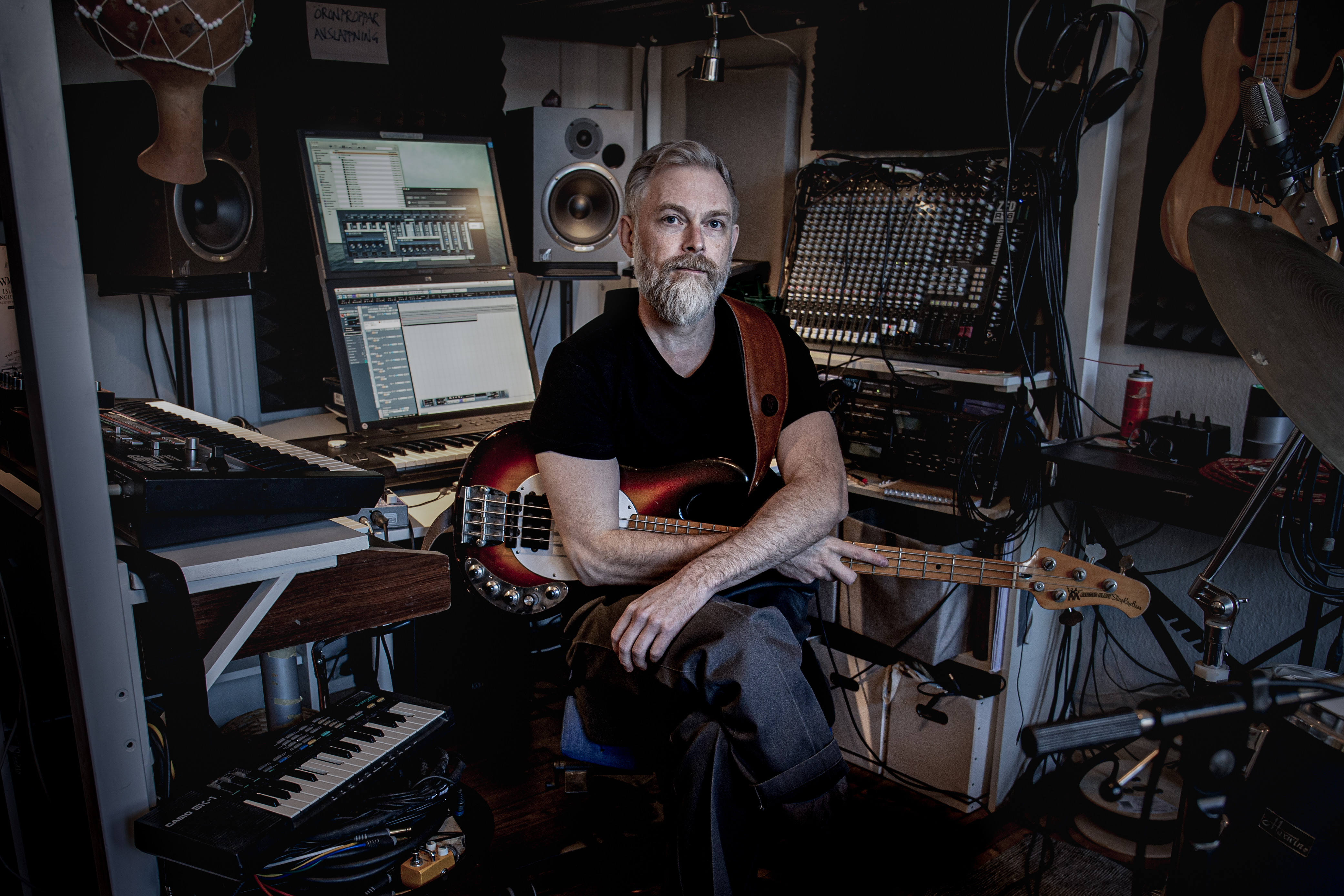
Jens Lodén, a Swedish producer, composer and bass player has had decades of music experience under his belt. Against all odds, autism, burnout, tinnitus, he has managed to have a successful career and express himself through music in a way which is both impressive and inspiring. His eclectic style and a collaborative approach have been the basis for Jens’ latest project, an album “They Say”. Released in May, it combines trip hop, jazz and electro-acoustic sounds, delivering emotions through a mix of soundscapes which invite the listeners to take an introspective trip into their own selves. I have recently spoken to Jens about his music and all the obstacles he has had to overcome to find himself in this very place in his life. A place that is never certain, never safe, but both creative and rewarding at the same time.

Bartek: When you look back at your decades-spanning music career, what is the most important thing that you would like people to know about you and your music?
Jens Lodén: The important things are that I’m always striving to do something original. And it’s kind of the mission of my whole life to add something new to the world and the people in it.
When you recall your first music experience, how do you think it has shaped your life?
Well, my first music experience is sitting at the piano when I was very small – I could just about climb up to the piano stool. I was pressing the keys on the piano and listening to what happened. I used to do that a lot since the first time I discovered it and it became my inner world, a kind of, how do you say, a sanctuary and a calm place away from everything else. Pretty introverted and autistic. I remember clearly starting to examine what happened when I pressed several keys at the time and hearing the overtones shifting, and I think that’s when some kind of curiosity for the puzzle of music started.
How did you discover trip hop?
It was Massive Attack in the early 90s, mid 90s. When I had difficulties with tinnitus, and I couldn’t do music for one and a half, two years for some reason “Protection” was the album I listened to very much, as well as “Timeless” by Goldie, but that was not exactly trip hop. And there’s something about the melancholic aspect of most of trip hop and the repetitive aspects, which for me is purely minimalistic. Repetitive music equals minimalism for me. And then, oh, I need to add actually the album “Sensory Man” by Spacer, an artist that was released on Howie B’s label Pussyfoot in the 90s. That album was not my discovery of trip hop, but it has been a really important influence.
So, a pretty usual, pretty common answer, it was Massive Attack.
Do you have an Artist, or an album that you would call unforgettable? One that you would not be able to live without, or that your music would not be the same without?
“Sensory Man” by Spacer, “Blue Lines” and “Protection” by Massive Attack. And then there’s a whole lot of funk for me. I started listening to funk when I was in my teens and it was actually a kind of not so super well-known group called Defunkt. An American group, with Joe Bowie as a lead figure on vocals and trombone, and Kim Clarke on bass. She played on a Music Man bass and played a lot of thumb bass. I was very influenced by her and that really explosive, and not very tidy funk music, with a lot of trombone solos. And then there’s “Prince Parade” which is special because that was the first time I saw Prince live. It was 1996 in Copenhagen, Prince and the Revolution… Wow, that is the foremost live experience I’ve had, I think. There’s also Arvo Pärt, the minimalist composer, there’s Thelonious Monk in the jazz field, and there’s Weather Report, and Jaco Pastorius.
If you were to sum up your latest album, “They Say”, with one-word emotion, which one would that be?
Communication.
And if you were to use more words to describe it?
“They Say” has been a way for me to find new ways, and sustainable ones, to make music with other people. I’ve had a pretty long period when I mainly did music on my own, and before that I played in bands, and it was very collaborative. But now, it is more about distance work and sending stuff to each other, which allows me to work at my own pace, and the people I work with, to work at their own pace, and for me not to be totally exhausted by the social interactions. It’s something like finding a workable solution. I don’t want to say a “safe” one, because there was lot of challenge involved, and challenges and uncertainty always have to be an ingredient if you’re going to make something good, in any field of art.
How has living with autism affected your approach to music?
Starting with the experience I talked about earlier, sitting by the piano, a couple of years old. I mean, I have been living with autism all my life, but I didn’t know it until I was about 40 when I got the diagnosis.
Well, I need to limit how much I participate in social interactions. It’s pretty much it, and I think it has a good effect because it has allowed me to discover who I am, what I like. I like to be on my own, I like to contemplate, I like to meditate, I like to delve into musical questions and explorations and I really, really enjoy doing this on my own, actually. But I needed to find some kind of way to give it a function and a meaning in relation to other musicians, and to get their input. But it’s a kind of a difficult equation to get right, find the balance between collaborating with others and getting the time for myself that I need.
What other health-related issues influenced your musicianship?
I have had burnouts and they are connected to the autism. But the first syndrome of burnout was that I was hit with a pretty severe tinnitus when I was only like 25. So, that had a massive impact, of course, and I got very sensitive to sound after that. I had a really bad sonophobia, fear of sound, and I quit music totally for almost two years. Tinnitus can be a tricky one because on one hand you need to not get too fixated on it and be afraid of it, but on the other hand you need to know your limits and not damage yourself again. Or more so, find a balance between exposure and safety.
Do you think that dealing with all these issues was ultimately, in any sense or form, a benefit that you would accept as a contributing factor to your music, despite all of its challenges?
I think, probably, I have talked about that because it has made me focus on my inner world and finding my way back to the same feeling, like sitting by the piano when I was little. Being present in the now. And instead of playing live, to take a step back from that. This has definitely contributed to what I have learned about producing and mixing, and recording. I don’t think I would have done that much otherwise, actually.
What comes after “They Say”?
Me and Lina Nyberg, a Swedish jazz singer who sings on two songs on “They Say”, we are in the early stages of an EP. Well, we think it will be an EP, maybe it will be more. With Noah Halfeld, the American cello player who plays on the track “The Gift”, I am exploring some kind of ambient which also is planned to be an EP. And that’s remote work – he’s north of New York and I’m here in the south of Sweden. We call it “Ambient over the ocean”. When “They Say” was finished, I – surprisingly to myself – started doing techno again. So, I don’t know what this will lead to, but I think I will do that under another name. Up to this point, I did everything under the name Jens Loden, but now I think “They Say” represents something, these collaborative processes combined, with me being the producer, the center of it all. This is what I would like to present as Jens Loden in the future. And if I release club music, minimal techno, tech house again, which seems like I will actually do, then that will be under some other name.
Finally, the vinyl edition of “They Say” is coming out late 2024 or early 2025.
Photos: Press release
0 comments on “Jens Lodén “Between Exposure and Safety””