
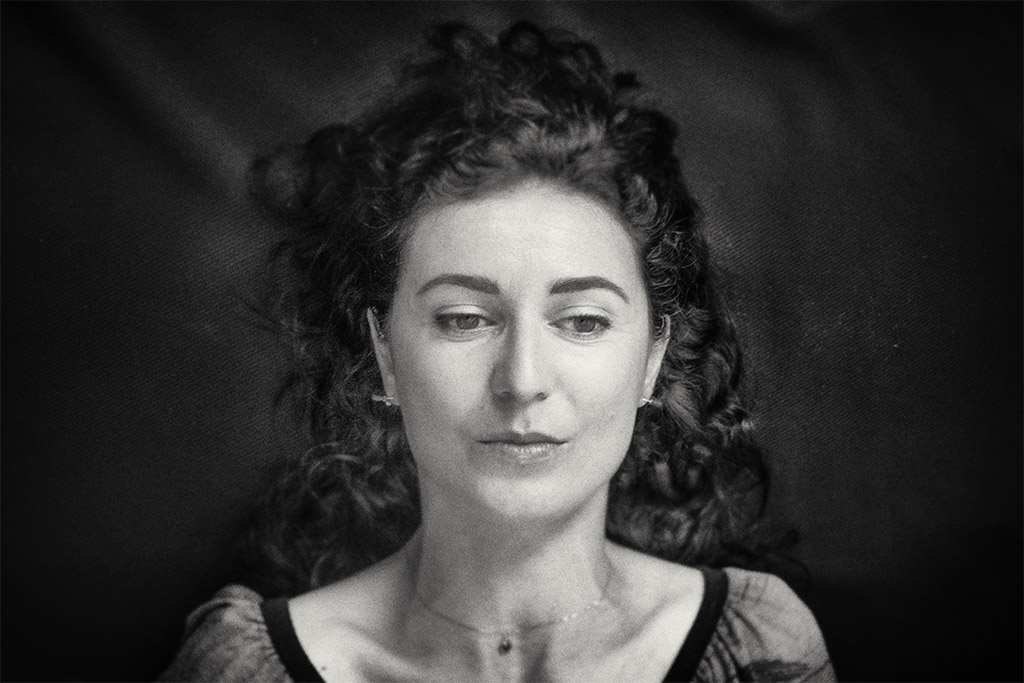
If you are lucky enough, you will find people in your life whose existence you take as obvious. Not for granted, but as obvious. As if they have always been there, even when they were not even part of your life yet. These amazing souls are equally physical as they are ethereal, hard to explain how, but once you get to know them, you usually cannot imagine your life without them. Weird? Confusing? Well. Here is a story of Camille. The singer and lyricist of ThunderFuzz whom I have been privileged to know for the last few years. Just like that, as if it has always been the case. Oh, and by the way, we have just released a new song together. Keep on reading and you will hear it at the right moment. The right moment is always important.
Bartek: You started playing piano at a young age. What impact did it have on your future life and professional choices?
Camille: Discovering the piano was decisive to me. It has shaped my life up to now. Practicing my instrument was my main activity until the end of high school, it introduced me to music. It conditioned my studies, since after my baccalauréat with a music option, I went on to study musicology.
I think I was fascinated by music – if not yet passionate about it – even before I started the piano. Very early, on a small synthesizer offered by my aunt, I would reproduce by ear the songs I heard on TV.
Without much hesitation, when it came to choosing a career path, I naturally decided to pursue my musical studies. Although it was clear to me that I wasn’t going to be a professional musician, I wanted to work in this field, either to help or to contribute to the success of other musicians, or by becoming a musicology researcher.
How did you deal with being scrutinised/judged as a musical performer at such a young age?
Very early, I have been identified by my friends and family as “the pianist” of the group, it made me feel valued. Implicitly, it’s like it gave me a place down here. I felt proud and very comfortable in this identity, until I discovered the Conservatoire world. The older you get and the further you progress in your training as a musician, the more demanding the requirements become. In addition, by specializing and focusing on music, you get surrounded by musicians, either in high school (since I was in Music class) or outside of the school, in the Conservatoire. You can feel the pressure because the level is high: whereas in middle school I seemed to be the only pianist in the band, in high school I found myself surrounded by musicians, each more talented than the previous one. Unlike many others who started directly in the Conservatoire, I began learning the piano and solfeggio in a small association. I joined the Formation Musicale class (solfeggio, theory, harmony) in Conservatoire at the age of 15, I was quite good in it. However, the practice side was another kettle of fish: I failed the entrance exam for the piano class. At the Conservatoire, there are age limits for each level. If you fail, that’s over for you… It was clearly a trauma for me, and the beginning of a very complicated relationship with my instrument.
What would you say are the main advantages and disadvantages of becoming a musician early in life?
The earlier you start learning an instrument, the easier it is to integrate the lessons. You develop a lot of good automatisms, your body memorizes movements more easily. Children have a huge capacity for learning things, and they also don’t have the fear or the stress of not playing well enough. That you get later with the fear of being judged. The only thing they want is to practice the piece of music until they master it and know it by heart.
The downside I can think of right now is, once you are identified as a musician very early in your life, everyone is expecting you to remain a musician for your entire life. It’s like you don’t have to choose another path, because it would be a pity not to exploit this ability.
Also, a musician who started learning music early is much more demanding of himself. He has less room for error than someone who started later, because his years of study during his youth presuppose that he has acquired a higher level.
Like many performers, you dealt with a “musician’s complex”. How did it affect you?
It’s actually still very present, although the ThunderFuzz experience helps me a lot to fight this feeling!
As I said previously, the Conservatoire experience was certainly the beginning of the musical complex.
As is the case for many artistic disciplines, music is an extremely demanding art form, especially when it comes to Classical and Jazz. It’s a very elitist environment, where the social class struggle is unfortunately re-enacted, it’s very tangible. Training on an instrument requires several hours of daily work. If you don’t practice during a week, it takes 2 weeks to get back to your level. Since we were assessed very regularly, the fear of failing exams is just harassing. It created too much pressure, and it has always been an issue for me to deal with stress.
In this environment, many young musicians, like me, simply lose confidence in themselves and their musicianship. How can we consider ourselves musicians, if it’s never good enough, if training never ends, if you fail the exams… You come to believe that if you’re not excellent, you’re not allowed to play.
I’m working on that complex, and today I’m more relaxed about it. Music is for everyone, and I understood it. Although I “allow” myself to sing in ThunderFuzz, I always have in mind that I am not a singer. I love singing, that’s for sure, and I have the right to sing. But I know what it takes to be a proper singer, years of daily, hard practice.
Do you remember your first-ever music experience?
This is a bit funny, the first music experience I remember is with a tape of Still Loving You – Scorpion. I remember listening to it on loop and very loudly, pressing endlessly the “rewind” button of my cassette player! Sitting down on the living-room floor, I think I was something like 4 or 5 years old. I still remember it well today.
Funny as well, the 2 first CDs I got for Christmas were Aqua – Barbie Girl, and an album of Alliage, a French boys band from the 90’s: I used to listen to these albums again and again, it makes me laugh today!
I also have a very old memory of me cooking with my grandmother, while listening to Charpentier’s Te Deum.
Which artist/performer, dead or alive, had the biggest influence on you?
It’s very hard to answer that question, but I’d probably say Frédéric Chopin. He has conditioned my musical tastes, but also some of my compositions. His aesthetic sounds still very modern to me, his influence can be felt in many of today’s pianists (Chilly Gonzales, Sofiane Pamart, etc.). Today’s piano music simply wouldn’t have seen the light of day without him. I may have listened to his Impromptus, Nocturnes and Études my entire life, but I still get the shivers when I listen to them. The emotion is intact. Chopin is undoubtedly one of my greatest sources of inspiration.
How did your music taste evolve over the years?
I’ve always been interested in every genre, that’s why I feel embarrassed every time someone asks me that question. I usually answer that I love music with a big M, meaning all kind of music, from Classical to Electronic, passing by traditional music from all over the world… Since we were analyzing a large variety of works and composers in class, I think I became extremely eclectic and cannot define myself with a single genre or artist. The only resistance I have is with Rap/Hip Hop, and some mainstream Pop artists, who simply don’t provoke any emotion in me. I’m also more sensitive to instrumental music, or to songs whose text I don’t understand. It’s as if understanding of the meaning of words cuts me off from the musicality of sounds.
But it’s true that if I had to analyze my musical journey, I’d say that it started with Classical, especially with composers of the piano repertoire (my favorites would be Liszt, Schubert, Schumann, Chopin, Debussy, Satie…). Then I had a jazzy period with a particular admiration to Herbie Hancock, Marcus Miller, Avishai Cohen. But we can also extend this list to Stevie Wonder, Carlos Santana, etc. My twenties were marked by long weekends in Rave/Free parties (I’m a big fan of Psytrance music) and the exploration of electronic music: Infected Mushroom, Highlight Tribe, the Prodigy, Autechre, Modeselktor, Venetian Snares, Ellen Alien, The Knife, etc.
What is your part of the ThunderFuzz story?
I’m the singer of the duo! I compose the vocal part for our songs, I write the texts, even though I grab Bartek’s brain quite often when I’m stuck! I met Bartek in 2020, we both work together in a Luxemburgish music company. We quickly became friends.
I think it started when we were asked to create a song for one colleague, for Secret Santa. I composed a silly Christmas song for a workmate and recorded me singing, accompanying myself on the piano.
Bartek loved my voice on the Christmas tune. He suggested to collaborate together, since he was producing electronic tracks, trip hop oriented, since a few years already. Not easy for me to accept due to the “musical complex” (or blockage) but also lack of time. I finally accepted a few months later, encouraged by a few strawberry mojitos. The next year, Anti Body came out!
What is the main message behind the latest single, “Stardust”?
Stardust has a very positive message. It is an invitation to see the beauty in every little thing that we usually take for granted. It sounds “banal” but it’s actually true: our modern lives have such rhythm and concerns that are far removed from the essential. It is true that we have very little time to marvel at anything. But also, the value today is given more to material things than to the life itself. It’s important not to lose our sensitivity to the simple, non-monetizable things that are offered to us, which although simple are nonetheless powerful and crucial! In these troubled times, Stardust spreads a message of love, peace and serenity.
Which topics interest you the most as a lyricist?
It’s easier to express myself with sounds than with words. Also, in my private life, words don’t come easy to me (as the song says 🙂 ). I think what interests me the most is talking about the “neuroses” of our century.
Exploring the contradictions of 21st century human beings, talking about the absurdity of our lifestyle. Review the torments of the human soul, basically! It’s easier to write lyrics in English, weirdly enough – despite my English level. As I said before, when the meaning of words is comprehensible, it’s hard for me to appreciate the sound, but also to be satisfied with the quality, the depth or the poetry of the text.
If there was one advice you could give to your younger self, what would it be?
Don’t forget the pleasure: emotion is more important than the technique.
What are your plans at the moment? What would you like to achieve in the future?
At the moment for ThunderFuzz, I’ve got two instrumentals from Bartek that I need to work on, slow, dark and trippy ones as usual! Although it’s quite hard to find some time to allocate to music, lately. We will also release an album (both digital and physical) around September, which consists of a rework of our debut album Anti Body. More news to come soon. As for my personal projects, in a far future, whenever it will be possible, I would like to record all my piano pieces. I’m very slow when it comes to composition (especially to write the scores) but over the years, I composed a couple of small contemporary piano pieces that I would like to bring together, as a testimony of me for the people I love.
Pingback: Interview with Camille – ThunderFuzz
Bravo, Camille and Bartek! Thank you for creating your lovely works.
Thank you so much, Silver Bella! <3
Thanks a lot for your kind words, dear Silver Bella! Camille
Very interesting and professional interview, brings back many memories. 😉 I loved that part about Secret Santa and the earliest music experiences (there’s nothing embarrassing about them). “Stardust” is amazing and the outro is a cherry on top. 😁
Greetings.
That’s so super cool of you to say that! I will make sure Camille knows! 🙂
And as for the outro – thanks so much! At first, I wasn’t sure I should even do it but, in the end, I am happy I did. Fun fact, well not so fun actually, is that I was straight after laryngitis when I recorded myself, so that’s where the voice got the extra grittiness from 🙂
Thank you so much for your comment, I’m really glad you liked the interview! 🤗