
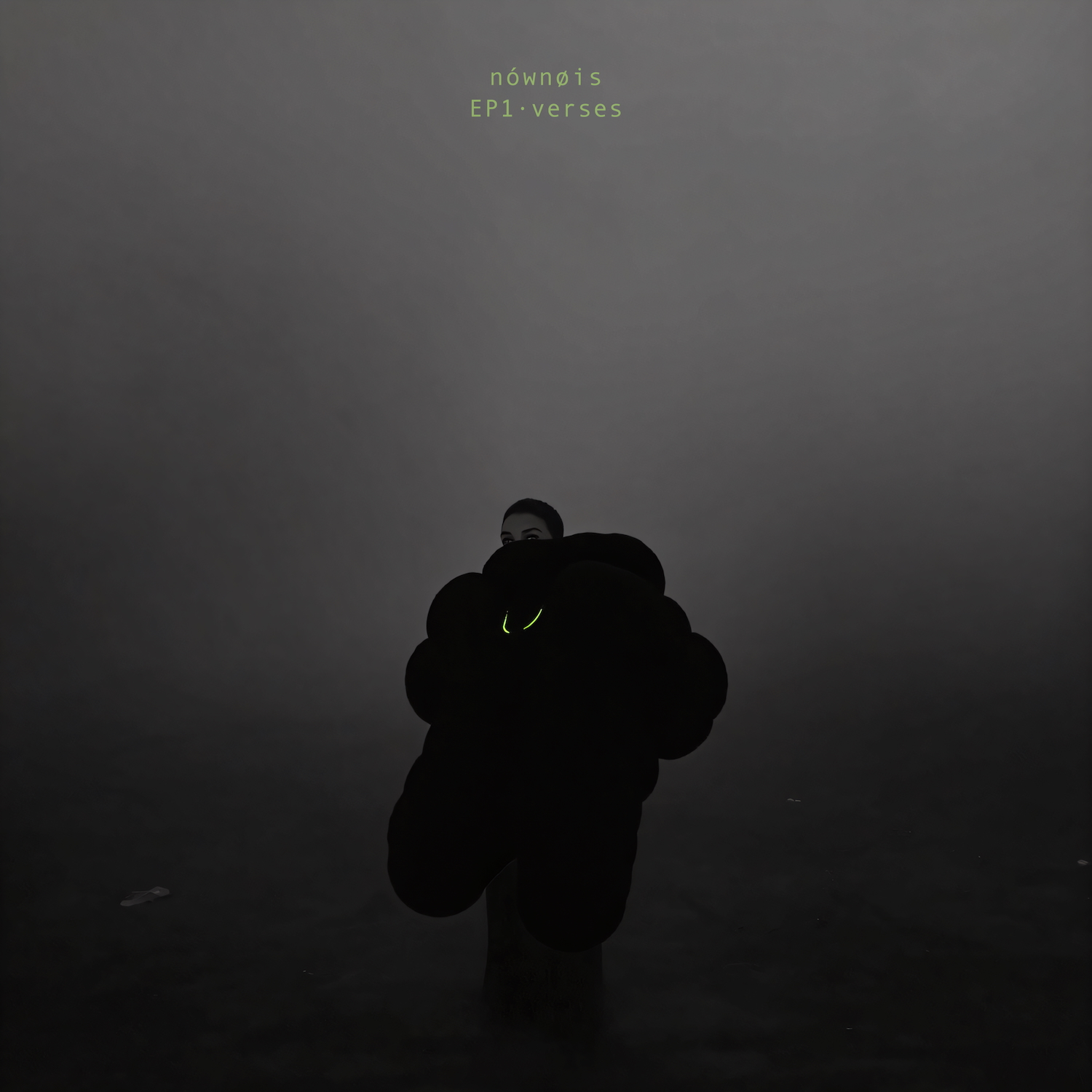
Meeting nównøis and experiencing her music is like peeling off layers of secrets. Layer after layer, patiently allowing yourself to feel the quiet whispers, fragments of thoughts, unexpected spikes of the noise, and the deep moments of silence. It is a riddle, one that gives you the real pleasure when you agree to explore it without any rush, or pressure, or any expectations, not to mention any rules. It requires time, and no time, at the same time – an oxymoron on a quantum level, as fascinating as its description. Not that you need any descriptions, though. Because, as contradicting as it sounds, the adventure lies in the experience alone. Without any clues or prompts. Just being there and feeling the music. Track by track.
“I wrote these five tracks in fragments”, says nównøis when introducing her debut EP, “verses”. “Each song is a small piece of a larger story I’m still learning to tell.”
I have recently had the pleasure of speaking to nównøis about her beginnings as an artist and a performer, as well as her artistical development which led to the creation of “verses”. I hope you will enjoy this slow unravelling of the mystery behind the five songs which make up the EP. Layer by layer, with no expectations.
Bartek: On Spotify you describe yourself using one sentence. “I make music for people who like being alone.” How does this description reflect your own personality and your relationship with “being alone”?
nównøis: Being able to spend time alone is essential for me. Almost like water, or breathing. One part of me dies if I can’t dive into my own strange little world without anyone interrupting, questioning my decisions, judging my half-ideas. I need the freedom to do all this to myself too: to change direction randomly, to doubt myself, to judge myself, and then to find a way out of it. Those are the moments when I can have a clear conversation with my subconscious, and that’s usually where a song starts. I imagined that to really take in every part of my music — the lyrics, the intentional beat changes, the sounds, the melodies, the meaning — one needs to be alone to fully listen. As much as I want to be right about that, I also love the idea that people can experience it in a club, a venue, or at a festival, surrounded by others, but still feeling like the music is talking only to them.
You started your musical journey as a stage performer with live bands. Could you share a bit about that experience?
Way before I joined my first band, I had already worked with producers since I was 16. Even earlier than that, I sang in a choir, with my cousin, or just while sitting on random stairs. But I officially joined my first band at 21, and it became a friendship-based, chaotic, beautiful seven years in the rehearsal room and on stage. That experience was very different from my next band, where the ever-changing line-up made it as challenging as it was exciting. I had to spend a lot of time learning the same songs over and over again for new members. After a while it felt like running on the spot. I also had to say no to great opportunities because the band wasn’t available, which was frustrating when I was ready to move. When I was left pretty much alone after releasing an LP in 2018, it was painful, but it was also very clear: if I wanted to keep going, I had to be able to stand on my own. That’s when I decided to get ready to perform alone — and to build something that couldn’t disappear just because someone quit a band.
One might say that you currently positioned yourself at the opposite end of this “spectrum” as a self-produced electronic music artist and performer.
Being a one-person project gives me more freedom, but also more responsibility, which is a different kind of stress. It has taken my desire for solitude to the next level. I grew up getting much less support in big decisions than a child might need, so I got used to doing things my own way. I’ve always needed time alone to write, to sing, to be unapologetically me.
Does “being alone” in that sense come to you at any price?
I do miss interacting with others on stage and in rehearsal rooms. I miss the jokes, the temporary friendships, the feeling of a shared mission. But the fact that I can now carry a set by myself, from the first sound to the last, makes me genuinely happy. Years ago, a musician friend told me after a gig that my music was only good because of the amazing musicians playing it. It hit hard, but a quieter voice in me disagreed. Establishing myself as a solo artist is also a way to build something solid, so if people do join later, they join something that already has a stable spine.
What would you say are the main differences between the music scenes in Hungary and the UK?
There’s a massive difference in attitude. In Hungary, I often felt surrounded by constant criticism, envy, and jealousy. I never studied music, so I struggled to communicate my ideas, even though I had many. They became clearer and clearer over time, but I had to make a lot of compromises. The older you get, the more you know yourself, and the less willing you are to compromise on the wrong things.
How did it change when you moved to the UK?
When I got back on stage at an Electronic Music Open Mic (EMOM) at the Dublin Castle in Camden a year ago, that moment changed everything. I was not ready, not even close to my best self, but the reaction and positive feedback were like a piece of bread for someone starving for six years. It reminded me that what I do actually reaches people. Now I’m finally getting appreciation from fellow artists, and I’m actively looking beyond that — craving a strong fan base outside the industry. For that, I need to let go of more parts of the old me. Another big difference is that in the UK, people seem overall more open to unfamiliar things. That openness gives you permission to experiment, and for someone like me, that’s priceless.
You open your new EP with the following sentence: “Hold on to your dignity, say goodbye to your insecurity”. Sounds like a much needed mantra for those who struggle with self-esteem. Does this reflect any of your personal experiences?
Completely. Self-doubt, fear of judgment, perfectionism and impostor syndrome are deeply rooted in me. They were blooming in a country where even my band members could be jealous of my small successes, where I was often treated as a dumb-ass b!tch for having slightly more feminine energy than a bearded metalhead, and where people didn’t always see me as an actual artist, just “someone who tries.” “Dignity” started as a mantra I wrote for myself a few years ago. I needed a sentence that held me together when I felt I was shrinking in certain rooms. It was like a small spell: “hold on to your dignity, say goodbye to your insecurity.” I wrote it for me, but I love that it now belongs to anyone who needs it.
“Distance (far)” is the most trip hop infused song on your EP. What has been your relationship with trip hop over the years?
I don’t really like calling myself a trip-hop artist, even though I understand why people hear that influence. My music shares some DNA with what we now call trip-hop, but it often lacks the classic repetitive downtempo beats I associate with the purest form of the genre. As a marketing specialist, I know how important it is to pick a box so people can find you. But as an artist, I find it limiting and a bit degrading. Once you’re placed in a box, it becomes easier to compare, easier to dismiss.
What would be your goal in that regard then?
What I really want is to build a world where people say: “this is nównøis.” It might borrow from trip-hop, ambient, dark pop, folk, whatever — but it’s its own small universe. Doing that takes time and a lot of work on the promo side, and right now I’m also a mum of two small children, with limited hours and budget. So, I move slowly but deliberately. I love that trip-hop can exist in its classic form and in new mutations at the same time — my place in it is to let that influence filter through me and become something more personal and slightly off-centre.
In “Rain Falling”, the melody you sing sounds almost Celtic, or medieval, or for the lack of a better word, folky. Was this intentional?
This contrast was probably the least intentional of all the subconscious decisions in my writing and production. I honestly hadn’t noticed it at first, because I don’t really sit down and analyse my music that way. A producer I met in London mentioned that folk flavour for the first time, and only then did I add it to my long, messy genre definition. Hungarian folk music is beautiful, and as a girl growing up in the countryside, I heard and sang folk songs from an early age. Apparently, that stayed with me in a very deep place. I like that these melodies sneak into electronic textures without asking permission.
“Dark Tune”, the fourth track, is largely instrumental. Its melody is practically asking for vocals, yet they don’t come, which – to me – means that it was a very conscious choice. Why?
In the first year of creating under the name nównøis, I was obsessed with found sounds (and not just nøis). My friend, the singer-songwriter Boohai, posted a video of himself playing one of his songs on guitar, and I caught this tiny bit in his intro: “dark tune.” I sampled his voice and started building a whole track around that little fragment. I wanted it on the first EP as a kind of flagship for what’s coming next: a slow move away from a purely vocal-centred approach towards a beat- and bass-centred, more experimental era that is clearly dark. The melody has never asked me for vocals. It simply replaced them 🙂
Are there any other reasons why you would need to focus on that instrumental aspect of your creativity?
On a practical level, I usually have to create while my kids are asleep in the same room, so I can’t always use my voice unless it’s already recorded. Since becoming a mum, I’ve had to learn to control creativity a bit more, to create inspiration instead of waiting forever. Some of my strangest, most interesting ideas were born in that quiet, restricted space.
The final track on the EP, “Incomplete”, by far the saddest in my opinion, tells a story of an emotional struggle. What would you say would be your personal search for “completeness”, artistically speaking? And when would you be ready to say you have achieved it?
One may never find completeness — otherwise the drive is gone.
“Incomplete” was my second self-produced nównøis single, and I’ve never been fully satisfied with it, which is quite on-brand considering the title. I started with a dark R&B-type beat and that tiny phrase: “I’m incomplete.” It felt like a moment when I finally accepted that fact, but without the usual fierceness and resistance that shows up in many of my songs. It’s more like the same cycle of suffering and resisting, but in peace and silence. Shinobu style. Artistically, I think my search for completeness is less about finishing a perfect work and more about building a body of work that feels honest and connected — like all the pieces are in the same room, even if none of them is “finished” in a traditional sense.
Let’s go back in time for a moment. I always ask this question. What’s your earliest memory of experiencing music?
And I always tell the same story: I’m sitting on the potty on top of my parents’ bed (don’t ask), with my older sister’s brand-new red cassette Walkman, “singing” Michael Jackson 🙂 It’s a ridiculous image, but it tells you a lot now that you know more about me.
You often perform on open mic nights. Which artist (dead or alive) would be your ultimate choice for a “partner in crime”, a dream come true of sorts, to perform with?
If you know him, tell Tricky he’s missing out.
Where would you like your EP to take you as the next step?
Releasing a larger body of work has been extremely important to me. I feel like the early experimental era of nównøis has come to an end and a clearer phase is starting. I want to get better at many aspects of being an artist — sound design, writing, and live performance will be in focus: tightening the set, pushing the production a bit further, but keeping the rawness, and expanding it with visuals.
Is there anything you wanted to achieve by completing the EP, any milestone, or a goal?
With this EP, I wanted to prove to myself that I know who I am and what I want to deliver, and that this is something I can stand behind fully. I am lucky to have a small but dedicated group of fans whohavebeen waiting for these songs, and who have been giving me hope that it’s worth sharing my music. These five tracks already tell a story, even though it’s just the first puzzle piece of a three-part EP series that will lead to a physical LP release in about a year’s time. My hope is that during this one-year journey I’ll find my audience — people who either like or don’t like being alone, but feel some kind of emotional relief in my music. People who hear these songs and think: “Oh. So, I’m not the only one who feels like this.” Whatever they feel.
Photo: Press release
More info: Website | Instagram | Facebook | SoundCloud | YouTube | TikTok
Special live event: Free Tickets (for those of you in and around London)
0 comments on “nównøis “Never find completeness. Otherwise the drive is gone.””